Learning a guitar solo from a YouTube lesson is mostly a problem of repetition and structure, not technique. You already have the tools — fingers, a guitar, a video. What’s missing is a way to put one phrase on repeat without losing your place.
Here’s the workflow that turns a 12-minute lesson video into a solo you can actually play.
Step 1: Watch the whole lesson once, hands off the guitar
Resist the urge to start playing immediately. Watch the lesson once through, all the way, with your hands in your lap.
You’re looking for three things:
- How many distinct phrases is the solo? Most solos break into 3–6 phrases, each separated by a breath, a chord change, or a position shift.
- Where are the hard spots? The bend you can hear is going to be hard, the fast run is going to be hard, the position shift you can barely see is going to be hard.
- What’s the tempo? Note the BPM in your head (“slowish blues,” “medium,” “fast eighth notes”). You’ll need a slow version of this in a minute.
Skipping this step is the #1 reason solos take three times longer than they should — you spend hours drilling phrase 2 before realizing phrase 4 is the actual problem.
Step 2: Loop the first phrase
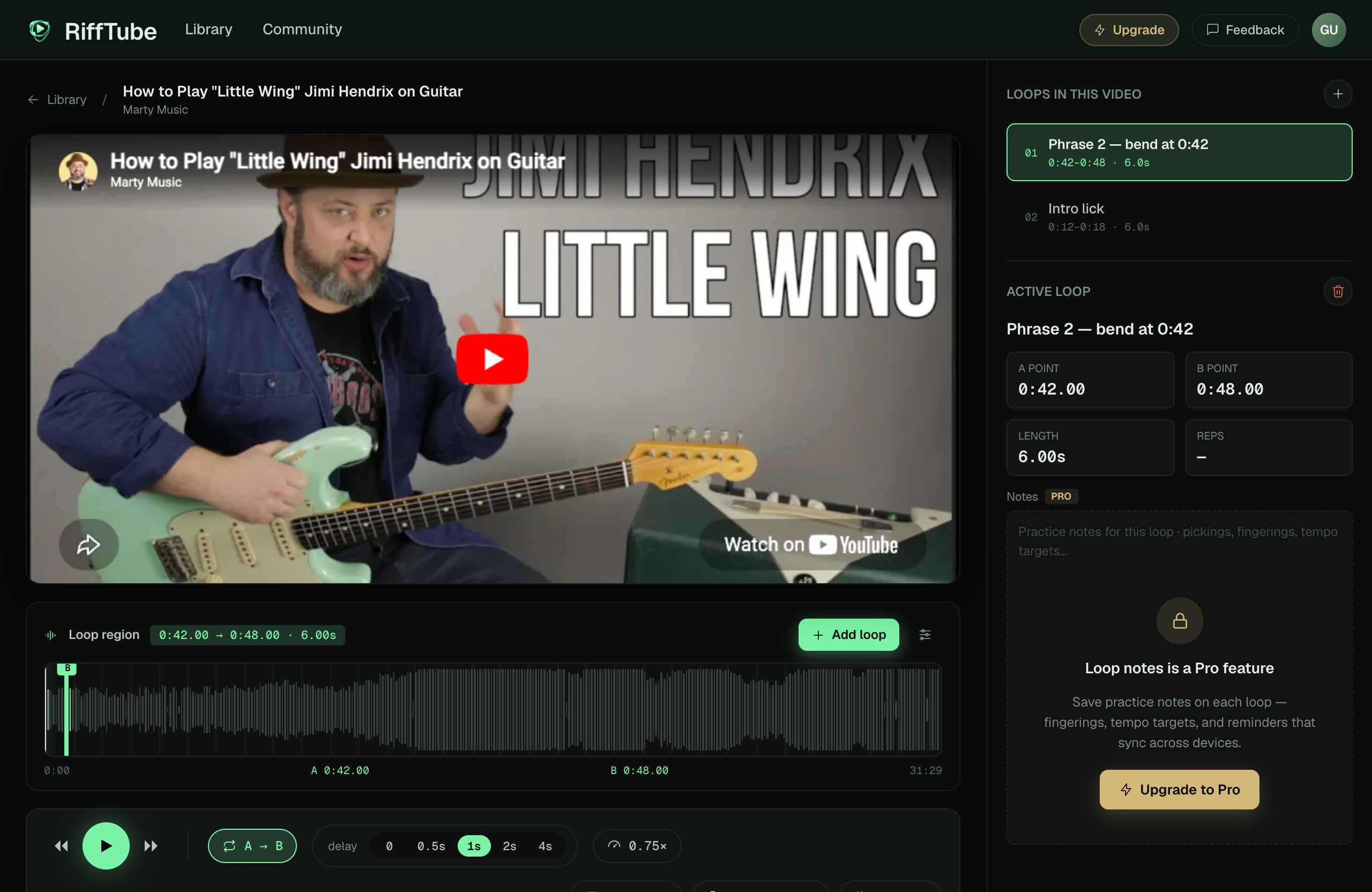
Open the lesson in RiffTube. Paste the URL, find the start of phrase 1, tap A. Find the end of the phrase (usually a held note or the start of the next phrase), tap B.
Now you have a 4–10 second loop. That loop is your whole world for the next 20 minutes.
If the start of the loop is off — A is half a beat early, or it’s catching the end of the previous phrase — use fine-tuning to nudge it. Solos are unforgiving about this; a loop that starts mid-bend will train you to play the bend wrong.
Step 3: Slow it down
Set the playback speed to 0.75× or 0.5× — it’s right under the loop controls on iPhone and on the web. YouTube’s pitch-correction keeps the notes in tune at slower tempos, so you can play along at the slow speed without retuning.
The rule: play it slow enough that your first attempt is clean.
If you can’t get through the phrase cleanly at 0.5×, the problem isn’t speed — it’s fingering. Stop, watch the teacher’s left hand again at the slow tempo, and figure out where they’re moving up the neck.
Step 4: Ten clean reps before you change anything
Set a replay delay of about 2 seconds between loops. That’s your reset window — left hand back to position, breath, ready.
Now play the phrase 10 times in a row, at the slow tempo. Count the clean takes. If you get to 10 and 9 of them were clean, move up one speed (0.5× → 0.75× → 1×) and reset the counter to zero.
The single most useful number in solo practice is how many clean reps you got in a row before you blew one. If it’s under 5, you’re going too fast. If it’s over 10, push the tempo.
Step 5: Stitch phrases together
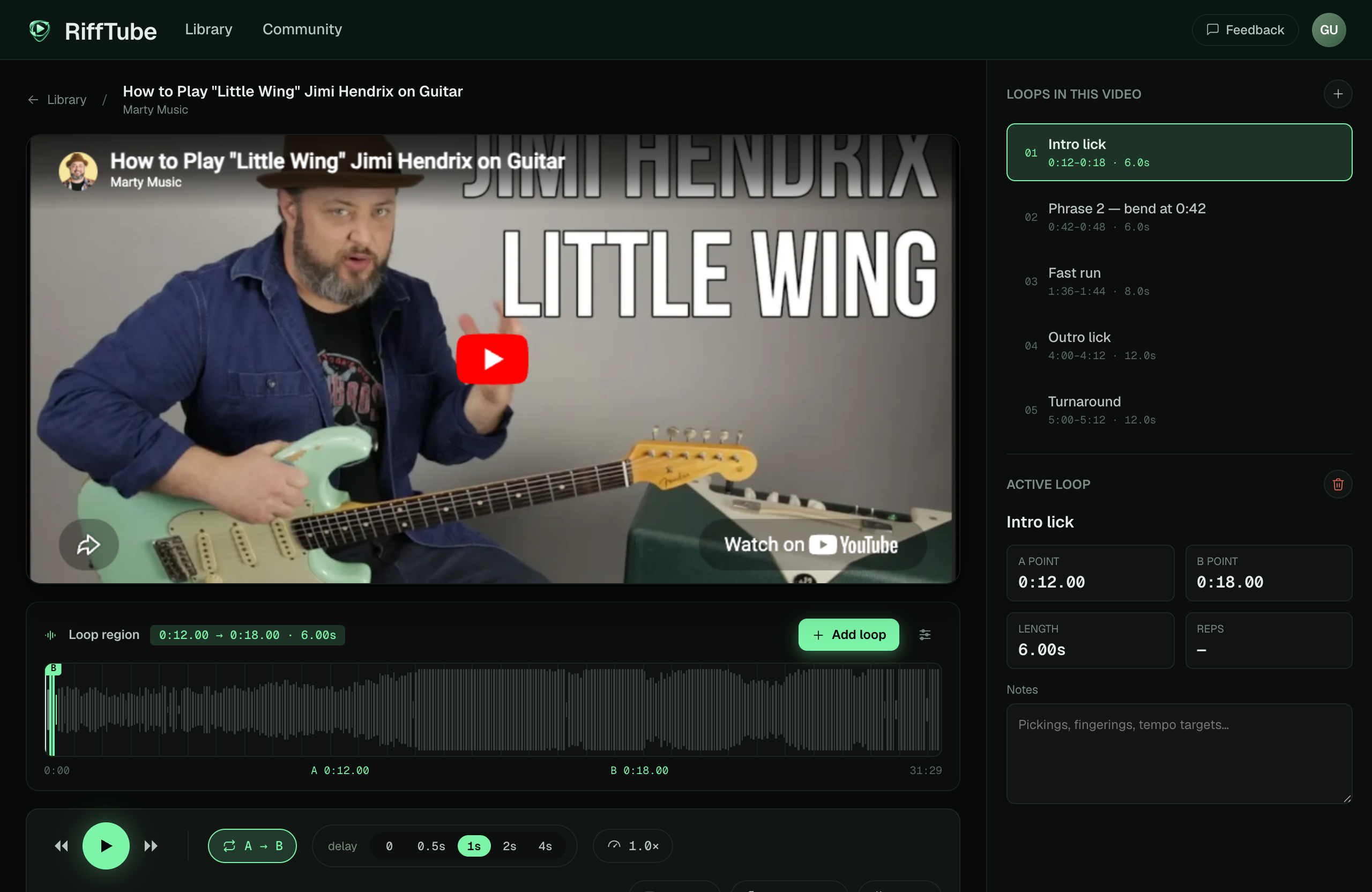
When phrase 1 is clean at full tempo, save the loop with a name, then move to phrase 2 and start over.
Don’t try to play the whole solo end-to-end yet. You’ll just bake in the wrong fingering for phrase 3 because you’re hurrying out of phrase 2.
Once you have all phrases saved and individually clean, expand a loop to cover two adjacent phrases and drill the transition. Transitions are their own thing — the last note of phrase 1 plus the position shift into phrase 2 is a mini-phrase that needs its own reps.
Step 6: Run the whole solo over a backing track
When every phrase and every transition is clean, find a backing track in the same key (YouTube has them for everything — search “{song} backing track guitar”). Paste that into RiffTube as a separate video, loop the section you care about, and play the solo over it without the original.
This is the moment you find out whether you actually learned the solo or just learned to mimic the lesson video. Mimicry collapses the second the lesson teacher isn’t playing it with you. The real solo is the one you can play over the backing track alone.
Why this is faster than “just play along”
Most people learn a YouTube solo by playing along with the lesson video. They watch it five times, play along three times, miss the same bend every time, and call it a session.
The loop workflow above puts you at 60–100 clean reps per phrase across a one-hour practice session, distributed across the 4–6 phrases that actually make up the solo. That’s where muscle memory comes from. Watching is not practice. Reps are practice.
Save the work for tomorrow
The whole point of saving named loops in RiffTube is that the next time you sit down, you don’t redo this setup. You open the video, your 5 named phrase loops are still there, you start with the weakest one, and you’re drilling reps in under a minute.
That’s the difference between practicing a solo for a week and practicing it for a month.